
Heritage Three Sisters Traditional Circle Garden
 In our effort to preserve the cultural legacy of the tribes of our region, the Nolumbeka Project stewards the Heritage Three Sisters Garden, and continues to cultivate ceremonial tobacco and other traditional native crops on the Wissatinnewag Site. Our goal is to educate others on the importance and vibrancy of Indigenous agriculture and to network with those interested in the preservation of heritage seeds, and other aspects of traditional Native American agriculture.
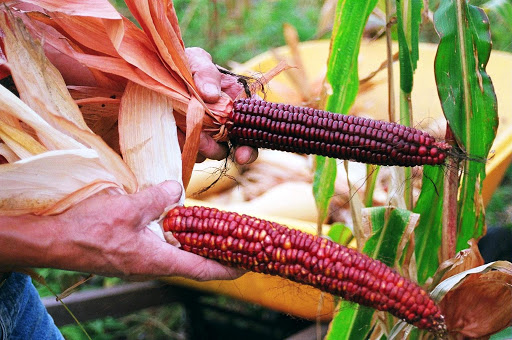
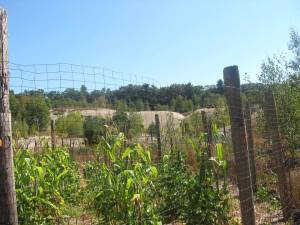
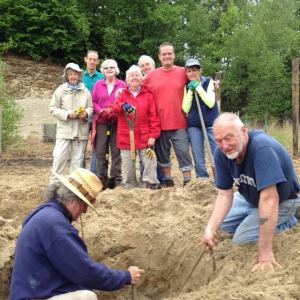
 Our reality is that the gardens are planted in the gaping sand pit left by gravel excavations. The measures of success vary from one year to another. We bring in topsoil and try to augment and build up the soil. We have raised perfectly formed red flint corn identical to what the colonists described they found when they landed in Plymouth in 1620. We lost all of the corn to crows in a single August 2016 afternoon. It is always a challenge to bring fertility to the gravel operation. We use a hand pump and watering cans – frequency depends on rainfall. When the gardens grow well they produce truly magnificent and meaningful crops. It is worth the extra time and effort and we’re so grateful to everyone who continues to nurture and build up the site year after year. Another gardening challenge is the welcome return of wildlife to the site, They appreciate the return of the traditional gardens, too!
Augmented by hunting and fishing, agriculture in the form of large-scale tribal acreage and smaller family “kitchen” circle gardens, sustained the Native American population of the Connecticut River Valley for thousands of years. The success of this agriculture often baffled colonists who relied on the European row and furrow system. They failed to recognize and appreciate the sophistication of an agricultural system developed for generations by a culture that emphasized interdependence and more readily perceived the symbiotic relationship among the elements of the natural world.
The foundational crops of tribal agriculture were commonly referred to as the Three Sisters: maize (corn), climbing beans, and squash. These crops had a symbiotic relationship during the growing process. The maize provides a structure for the beans to climb. The beans provide nitrogen to the soil for the others. The squash leaves act as a living mulch to prevent the growth of weeds and retaining moisture in the soil. The prickly hairs of the squash vines deterred pests.
As well as supporting one another through the growing cycle, the Three Sisters complemented one another when eaten. As Western science came to understand much later, maize lacks niacin, and both lysine and tryptophan, two essential amino acids that the body needs to produce protein. Beans provide ample quantities of each.
In addition, the Three Sisters were planted in flattened hills about three feet across and ten inches to a foot high, so that the solar heating effect extended the growing season substantially–equivalent to locations 500 miles to the south when planted with European row and furrow methods!
 Another natural resource, the abundant alewives netted in the annual spring harvest of fish along the Connecticut River and its tributaries (including salmon, eel, and shad), were used as fertilizer to enrich the soil and increase yields. This was an ingenious way to store energy from what would otherwise have been a limited and perishable resource and transfer it to crops which could then be dried and stored for use during the cold winter months. The rotting of the fish and plant materials buried in the mound would keep the roots warm in the cold nights of early spring Our Heritage Three Sisters Circle Garden is a re-creation of the kitchen gardens planted near the lodges of families. They were even more efficient than the large-scale tribal plantings because they could be more easily monitored to prevent loss due to rodents and birds. In addition to the three sisters, we grow a number of other useful and nutritional traditional crops including ground nuts, ground cherries, ceremonial tobacco, white sage, jerusalem artichokes, pollinator plants, and sweet grass. The seeds of these crops are dried and saved for use in future plantings and shared with the public and other seed preservation organizations across the Northeast and beyond. The sage, tobacco, and sweetgrass are given to our First Nations friends.
If you are interested in learning more about this project or assisting in any way please contact us at nolumbekaproject@gmail.com


 Nolumbeka Project